Introduction & Overview
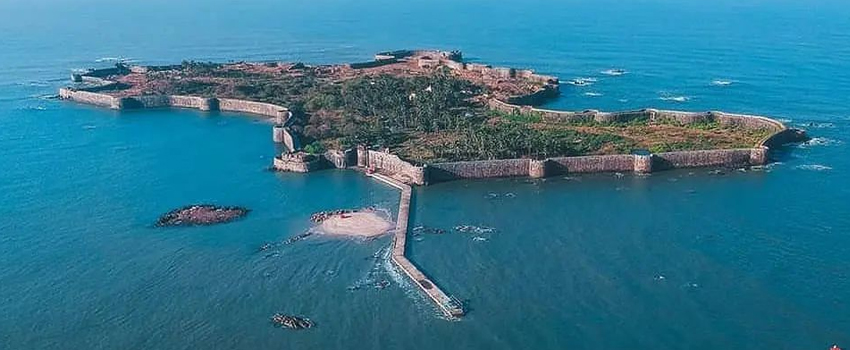
Sindhudurg Fort, perched on a rocky islet off the coast of Malvan in the Sindhudurg district of Maharashtra’s Konkan region, stands as one of the finest examples of Maratha maritime architecture. Constructed between 1664 and 1667 under the direction of Chatrapati Shivaji Maharaj, it was designed to safeguard the coastline from foreign naval powers and safeguard Maratha sea routes.
Situated merely 300 meters from the shoreline in the Arabian Sea, the fort spans roughly 48 acres and is encircled by massive granite walls rising up to 12 meters above sea level. Its vantage point offered comprehensive views of surrounding waters, allowing Maratha sentinels to monitor shipping lanes and prepare swift defensive actions against Portuguese, Siddi, or European intruders.
The fort’s distinctive hexagonal layout features 42 bastions and 19 gateways, layered behind a seawater moat and accessible via a narrow stone causeway. Within its ramparts lie the ruins of a royal palace, quarters for soldiers, ammunition stores, freshwater wells, and a Ganesh temple—demonstrating its capacity to function as a self-reliant stronghold during prolonged sieges.
Today, Sindhudurg Fort is protected by the Archaeological Survey of India and draws visitors for its rugged beauty, rich biodiversity, and well-preserved structures. The recent addition of a functional lighthouse and basic visitor amenities has further enhanced its appeal as a window into the Maratha navy’s golden era and coastal heritage.
Key Highlights
- Built by Chatrapati Shivaji Maharaj between 1664 and 1667 as a strategic maritime fortress
- Features a hexagonal design with 42 bastions and 19 gateways
- Surrounded by a seawater moat and connected to the mainland by a narrow causeway
- Houses ruins of a royal residence, a Ganesh temple, soldier barracks, and an ammunition depot
- Maintained by the ASI with a working lighthouse and basic visitor facilities
Historical Background
The story of Sindhudurg Fort begins in 1664, when Chatrapati Shivaji Maharaj recognized the necessity of establishing a powerful naval presence to defend the Konkan coast. Under the leadership of Admiral Kanhoji Angre and supervision of engineer Hiroji Indulkar, local granite was quarried and assembled into formidable ramparts, completing the fort’s core structure by 1667.
During the Maratha era, Sindhudurg served as the principal base for the growing Maratha navy, facilitating shipbuilding, training of sailors, and deployment of maritime expeditions. Its strategic position enabled surveillance of merchant traffic and rapid response to threats from Portuguese trading posts and Siddi fleets operating in the western sea.
After the decline of Maratha naval power in the late 18th century, the fort passed through Peshwa administration and was ultimately surrendered to the British East India Company in 1818. Neglected for many decades, it fell into disrepair until mid‑20th‑century restoration efforts by the ASI and local authorities revived key structures, preserving Sindhudurg’s legacy as a monument to Maratha maritime ingenuity.
Pre-1664 CE: Kurte Island under Bijapur Sultanate
Small fishing hamlet and lookout under regional Muslim rulers.
1664: Foundation Laid by Chatrapati Shivaji Maharaj
Architect Hiroji Indulkar begins construction with 2,000 artisans.
1667: Fort Fully Operational
Sea gate, ramparts, moats, and initial bastions completed.
1670s: Establishment of Dockyards & Shipbuilding
Workshops erected for constructing and maintaining Maratha naval vessels.
1673: Maratha–Siddi Naval Skirmishes
Siddi fleet attacks repelled by fort garrison.
1680: Death of Chatrapati Shivaji Maharaj
Naval command transitions to his successors.
1690: Under Admiral Kanhoji Angre’s Command
Fort becomes principal base for Maratha naval chief.
1707–1729: Kanhoji Angre’s Naval Campaigns
Series of victories against British and Portuguese.
1755: British Naval Bombardment Attempt
Maratha garrison repels Royal Navy ships.
1803: Decline of Maratha Navy
East India Company gains influence; reduced upkeep.
1818: British Conquest
Fort surrenders peacefully to British forces.
1838: Lighthouse Constructed
British build navigational beacon atop ramparts.
1917: Early Restoration Efforts
Local Malvan community begins minor repairs.
1925: ASI Protection Status
Declared a protected monument under Ancient Monuments Act.
1985–1990: Major Restoration & Tourism Boost
ASI-led reconstruction and visitor facilities established.
Present Day: Conservation & Maritime Heritage Revival
Annual Sindhudurg Utsav and scholarly events celebrate legacy.
Architectural & Structural Details
Sindhudurg Fort exemplifies the maritime architectural ingenuity of the Maratha Empire. Occupying roughly 48 acres on a coral‑rock islet in the Arabian Sea, the fort’s design seamlessly integrates natural sea defenses with human engineering to serve defensive, naval support, and community functions.
Fort Layout & Access Points
The hexagonal fort is crafted from locally quarried laterite stone and linked to the mainland via a narrow stone causeway that emerges at low tide. The main entrance, Rajbandh Gate, features massive wooden doors reinforced with iron spikes and a curved ramp, forcing would‑be attackers into a confined pathway exposed to artillery from above.
Defensive Structures
Sindhudurg’s ramparts comprise 42 rounded bastions (buruj), each equipped with multiple embrasures for cannons and swivel guns. The outer curtain wall rises approximately 12 meters above sea level, while the surrounding seawater moat floods at high tide, creating an additional barrier against scaling attempts.
Naval & Support Facilities
Inside the ramparts lie the remnants of a dockyard and storage warehouses essential for shipbuilding and armament supplies. Soldiers’ barracks, ammunition depots, and a series of rock‑cut platforms near the shore streamlined the loading of vessels and maintenance of naval assets.
Water Management Systems
Although situated offshore, Sindhudurg boasts several rock‑cut freshwater wells and cisterns embedded in the basalt foundation. The largest tank, known locally as Takmak Tokari, captured monsoon rains, ensuring a reliable water source throughout the year.
Religious & Communal Structures
A modest Hemadpanti‑style temple dedicated to Lord Ganesh stands near the fort’s center, accompanied by a small mosque, reflecting the pluralistic ethos of the Maratha Navy. Communal kitchens and briefing halls facilitated daily gatherings and strategy meetings.
Strategic & Military Importance
Sindhudurg Fort represents one of the finest examples of Chatrapati Shivaji Maharaj’s naval foresight and engineering skill. Its establishment as a coastal stronghold was driven by a careful evaluation of maritime threats, trade routes, and logistical support for the Maratha navy.
Geographical Advantage
Located roughly 300 meters off the Malvan coast in Maharashtra’s Konkan region, the fort occupies an island position that provided panoramic views across the Arabian Sea. Elevated walls and strategic bastion placements allowed sentinels to monitor approaching merchant and hostile vessels from a distance.
Natural tidal currents and surrounding shoals complicated navigation for unfamiliar ships, granting Maratha defenders precious time to prepare defensive measures or launch counterattacks.
Defensive Innovations
The fort’s hexagonal layout, with walls angled to eliminate blind spots, ensured overlapping fields of fire from its 42 bastions. Hidden embrasures and inward‑curving approach ramps further disrupted enemy formations and concealed artillery placements until the last moment.
At high tide, seawater flooding created an effective moat, while the robust laterite walls absorbed and deflected cannon fire, demonstrating advanced adaptation to naval warfare.
Self-Sufficiency & Siege Resistance
Sindhudurg’s freshwater wells and rainwater cisterns ensured sustained water availability, while granaries and dried provisions stocked ample food supplies. These provisions enabled the garrison to endure extended blockades without immediate mainland support.
Integrated naval workshops allowed on‑site repair of vessels and manufacturing of ammunition, reducing reliance on external logistics during protracted conflicts.
Role in Maratha Military Strategy
As the principal naval bastion of the Maratha Empire, Sindhudurg served as a launch point for expeditions against Portuguese, Siddi, and European trading interests along India’s western coast.
It functioned within a network of coastal forts, interconnected by signal fires, couriers, and patrolling ships, enabling rapid communication and coordinated defense across the Konkan belt.
Cultural, Social, & Religious Significance
Beyond its martial purpose, Sindhudurg Fort emerged as a cultural and social hub for the coastal communities of the Konkan region, blending maritime traditions with diverse religious practices and local folklore.
Religious Structures & Practices
The fort’s Ganesh temple, constructed in the robust Hemadpanti manner, remains an active place of worship, especially during the annual Ganesh Chaturthi festival when devotees gather to offer prayers for safe voyages.
A small shrine to Goddess Bhagawati underscores the Maratha Navy’s reliance on divine blessings for protection at sea, illustrating the syncretic religious environment fostered within the fort’s walls.
Naval Ceremonies & Traditions
Sindhudurg hosted ritual ceremonies to bless newly built ships at its stone jetty, where priests performed prayers and lighted lamps before each maiden voyage.
Regular flag hoisting and drum ceremonies marked changes of command and significant festivals, reinforcing naval discipline and camaraderie among officers and sailors.
Folklore & Legends
Local legends speak of a secret underwater passage linking Sindhudurg to neighbouring Vijaydurg Fort, purportedly used for clandestine naval operations—though no tangible evidence has surfaced.
Fisherfolk recount tales of protective sea spirits inhabiting the fort’s ramparts, believed to shield respectful visitors from storms and maritime calamities.
Modern Cultural Significance
Today, Sindhudurg Fort is a focal point for cultural tourism, drawing historians, scuba divers exploring submerged walls, and heritage enthusiasts keen to witness Maratha naval heritage firsthand.
The annual Sindhudurg Mahotsav features boat races, cultural performances, and guided heritage walks, celebrating the fort’s legacy and supporting the local Konkan economy.