Introduction & Overview
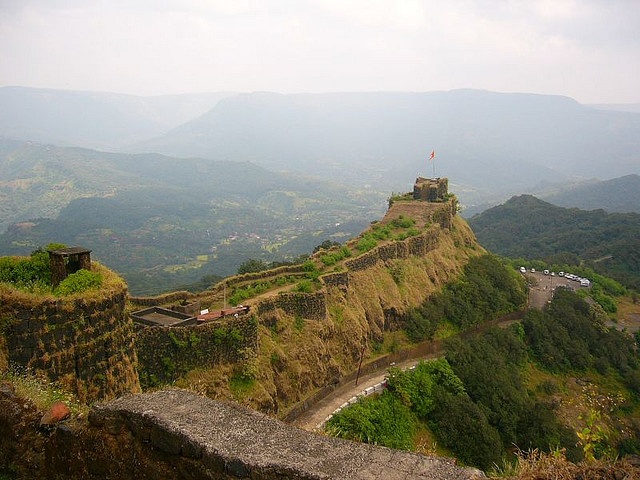
Pratapgad Fort, standing proudly atop a mountain in the Western Ghats of Maharashtra, is one of the most historically significant forts in India. Commissioned by Chatrapati Shivaji Maharaj in 1656, this formidable structure witnessed the legendary Battle of Pratapgad in 1659, which established Chatrapati Shivaji Maharaj as a formidable military leader and strategist.
Located at an elevation of approximately 1,080 meters (3,540 feet) above sea level, Pratapgad offers sweeping views of the verdant valleys below and the majestic Sahyadri mountain range. The fort's strategic position allowed Maratha forces to monitor and control the vital trade routes passing through the Par pass and the road to Raigad.
Pratapgad is uniquely divided into two distinct sections: the lower fort (Hyadi Buruj), which served primarily as a military garrison, and the upper fort, which housed temples and living quarters. This dual design perfectly embodied Chatrapati Shivaji Maharaj's philosophy of combining military pragmatism with spiritual reverence.
Today, Pratapgad Fort stands as a protected monument under the Archaeological Survey of India and continues to draw thousands of visitors annually. It serves as a tangible testament to the military brilliance, strategic foresight, and cultural heritage of the Maratha Empire under the leadership of Chatrapati Shivaji Maharaj.
Key Highlights
- Site of the historic Battle of Pratapgad (1659) where Chatrapati Shivaji Maharaj defeated Afzal Khan
- Features the iconic bronze statue of Chatrapati Shivaji Maharaj mounted on horseback
- Houses the revered Bhavani Temple, personally consecrated by Chatrapati Shivaji Maharaj
- Contains multiple water cisterns and granaries designed for long-term sustainability
- Exhibits exceptional military architecture with multiple defensive layers and strategic bastions
Historical Background
The history of Pratapgad Fort is intimately tied to the rise of Chatrapati Shivaji Maharaj and the Maratha Empire. Recognizing the strategic importance of the location, Chatrapati Shivaji Maharaj commissioned the construction of Pratapgad in 1656, entrusting the project to Moropant Trimbak Pingle, his trusted Prime Minister (Peshwa).
The fort's name, Pratapgad, translates to "Fort of Valor," a fitting designation for a structure that would soon bear witness to one of the most significant battles in Indian medieval history. The construction was completed in 1658, just in time to play a pivotal role in the unfolding conflict with the Adilshahi Sultanate of Bijapur.
On November 10, 1659, Pratapgad became the site of the legendary Battle of Pratapgad, where Chatrapati Shivaji Maharaj confronted and ultimately killed Afzal Khan, a formidable general of the Adilshahi forces. This victory was not merely a military triumph but a turning point that established the Maratha Empire as a dominant force in the Deccan.
Pre-1656: Strategic Assessment
Chatrapati Shivaji Maharaj identifies the strategic location; preliminary surveys conducted for fort construction.
February 1656: Construction Begins
Moropant Trimbak Pingle oversees initial groundwork; local materials sourced for rapid construction.
March 1656: Bhavani Temple Foundation
Foundation laid for the sacred Bhavani Temple at Chatrapati Shivaji Maharaj's command; spiritual center takes priority.
1656–1657: Lower Fort Completion
Military sections constructed; barracks, stables, and outer defenses established for garrison forces.
1657–1658: Upper Fort Development
Residential quarters, administrative buildings, and additional water cisterns constructed; temple complex completed.
August 1658: Fort Inauguration
Chatrapati Shivaji Maharaj officially inaugurates the completed Pratapgad; Bhavani Temple consecrated with Vedic rituals.
September 1659: Strategic Preparations
Chatrapati Shivaji Maharaj fortifies Pratapgad in anticipation of Adilshahi response; plans guerrilla defense strategy.
November 10, 1659: Battle of Pratapgad
Historic confrontation between Chatrapati Shivaji Maharaj and Afzal Khan; Maratha victory signals rise of new power.
1660–1674: Fortification Enhancements
Additional defensive structures added; water conservation systems expanded; garrison strength increased.
1674–1680: Coronation Period
Following Chatrapati Shivaji Maharaj's coronation, Pratapgad serves as secondary administrative center during seasonal movements.
1680–1707: Succession Period
Fort maintained as key stronghold during Sambhaji's rule; withstands Mughal expansion efforts under Aurangzeb.
1708–1818: Peshwa Administration
Under Peshwa control, fort serves as regional administrative center and monsoon retreat for officials.
1818: British Acquisition
Fort passes to British control following Third Anglo-Maratha War; minimal garrison maintained.
1957: Monument Status
Declared protected monument under Archaeological Survey of India; initial conservation efforts begin.
1957–1962: Statue Installation
Bronze equestrian statue of Chatrapati Shivaji Maharaj installed near Afzal Khan's tomb; becomes iconic landmark.
Present Day: Heritage Preservation
Ongoing ASI conservation efforts; annual commemorative celebrations of Battle of Pratapgad; major pilgrimage and tourism site.
Architectural & Structural Details
Pratapgad Fort exemplifies the distinctive architectural style of Maratha military fortifications, characterized by its intelligent adaptation to the mountainous terrain and emphasis on defensive capabilities. Spanning approximately 6.5 acres in total area, the fort demonstrates Chatrapati Shivaji Maharaj's profound understanding of military architecture and terrain utilization.
Fort Layout & Structure
The most distinctive feature of Pratapgad is its division into two main sections: the Lower Fort (Hyadi Buruj) and the Upper Fort. The lower fort, larger in area, served primarily military purposes with extensive barracks, stables, and ammunition storage facilities. The upper fort, more compact and elevated, contained religious structures and accommodations for the fort administrators and dignitaries.
Defensive Structures
The fort's defensive system features multiple layers of fortification with walls ranging from 12 to 40 feet in height. The main entrance, guarded by sturdy wooden doors reinforced with metal spikes, is approached through a winding pathway that exposes potential attackers to defensive fire from multiple angles. The Mahadarwaja (Grand Gate) is strategically positioned to force a sharp turn in the approach, breaking the momentum of any charging force.
Water Management Systems
Given its elevated position, water management was a critical consideration in Pratapgad's design. The fort contains several ingeniously designed water cisterns that harvest rainwater. The largest of these, Dhankoshi, could sustain the fort's population during prolonged siege conditions. Channels and conduits direct rainwater from the fort's expansive rooftops and plateaus into these storage reservoirs, demonstrating advanced hydrological engineering for the period.
Religious & Administrative Structures
The upper fort houses the renowned Bhavani Temple, personally established by Chatrapati Shivaji Maharaj. Built in the regional temple architectural style with influences of both Deccan and Hemadpanti designs, the temple features a sanctum housing the deity Goddess Bhavani, Chatrapati Shivaji Maharaj's family deity. The temple complex also includes smaller shrines dedicated to Lord Ganesha and other deities.
Construction Materials & Techniques
The fort is primarily constructed using locally quarried basalt stone, bound with lime mortar fortified with jaggery, pulses, and other organic materials that enhanced its bonding strength. The walls were constructed using the dry masonry technique in many sections, allowing for flexibility that could withstand earthquakes common to the region. Interior structures feature woodwork typical of 17th-century Maratha architecture, with detailed carvings and functional design elements.
Strategic & Military Importance
Pratapgad Fort represents one of the finest examples of Chatrapati Shivaji Maharaj's strategic genius and military foresight. Its construction and position were carefully planned to serve multiple tactical objectives within the broader framework of Maratha military doctrine.
Geographical Advantage
Positioned at the convergence of the Par and Koyna valleys at an elevation of 1,080 meters, Pratapgad commanded exceptional visibility across the crucial trade and military routes connecting the coastal regions with the Deccan plateau. This vantage point enabled Maratha forces to monitor movement across vast distances, providing critical intelligence and reaction time.
The fort's location on a steep mountain with limited approach routes made it naturally defensible, requiring minimal manpower to secure against even sizeable enemy forces. The surrounding dense forests provided additional natural protection and offered cover for Maratha guerrilla operations in the region.
Battle of Pratapgad & Military Significance
The fort gained eternal military significance as the site of the historic Battle of Pratapgad on November 10, 1659. This confrontation between Chatrapati Shivaji Maharaj and the Adilshahi general Afzal Khan demonstrated Chatrapati Shivaji Maharaj's tactical brilliance in choosing terrain that neutralized the enemy's numerical advantage.
Prior to the battle, Chatrapati Shivaji Maharaj carefully positioned his forces in the forests surrounding Pratapgad, creating an elaborate ambush system. When the Adilshahi army approached, they were channeled into unfavorable positions where their cavalry and conventional battle formations became ineffective against the highly mobile Maratha forces emerging from multiple directions.
Role in Defensive Network
Pratapgad formed an integral part of Chatrapati Shivaji Maharaj's comprehensive network of forts across the Western Ghats. It maintained communication links with nearby forts including Raigad, Torna, and Rajgad through a sophisticated system of signal fires, messenger routes, and visual communication methods.
This interconnected defensive system allowed for rapid response to threats, resource sharing during conflicts, and coordinated military operations across the Maratha territory. Pratapgad specifically protected the approach routes to the Maratha heartland and provided a secure base for offensive operations against the Adilshahi territories.
Logistical Capabilities
The fort was designed with extensive self-sufficiency features to withstand prolonged sieges. Its elaborate water collection systems, granaries, and armories could sustain a substantial garrison for months without external support. These capabilities made it an ideal forward base for Maratha military operations, providing secure logistical support for campaigns in surrounding territories.
Additionally, the fort's dual structure allowed for efficient separation of military and administrative functions. The lower fort's extensive military facilities could accommodate substantial forces when needed, while the upper fort provided secure command facilities where strategic planning could be conducted away from the main garrison areas.
Cultural, Social, & Religious Significance
Beyond its military significance, Pratapgad Fort holds profound cultural, social, and religious importance in Maratha history and continues to serve as a spiritual center and symbol of regional identity to this day.
Spiritual Center: The Bhavani Temple
The Bhavani Temple at Pratapgad represents one of the most significant spiritual sites in the Maratha cultural landscape. Personally established by Chatrapati Shivaji Maharaj, the temple is dedicated to Goddess Bhavani, the family deity of the Bhonsle clan and Chatrapati Shivaji Maharaj's spiritual guide throughout his campaigns.
Historical accounts record that before confronting Afzal Khan, Chatrapati Shivaji Maharaj sought divine blessing at this temple. It is said that the goddess bestowed upon him the famous Bhavani Sword and tiger claws (bagh nakh) that he later used in his confrontation with Afzal Khan. This spiritual connection transformed the temple into a symbol of divine sanction for the Maratha resistance against foreign domination.
Symbol of Maratha Identity & Pride
The victory at Pratapgad marked a turning point in establishing Maratha sovereignty and has become emblematic of Maratha pride and identity. The fort represents not just a military triumph but the cultural and spiritual resilience of the Maratha people under Chatrapati Shivaji Maharaj's leadership.
The imposing bronze statue of Chatrapati Shivaji Maharaj on horseback, installed at Pratapgad in 1957, has become an iconic landmark and pilgrimage site. Standing 17 feet high, the statue depicts Chatrapati Shivaji Maharaj in his moment of triumph, serving as a powerful visual reminder of his legacy and the values he embodied.
Folklore & Cultural Traditions
Numerous legends, ballads, and folk narratives (povadas) associated with Pratapgad have been preserved in Maratha oral tradition. These cultural expressions detail the events surrounding the Battle of Pratapgad, often embellished with supernatural elements that highlight Chatrapati Shivaji Maharaj's divine protection and extraordinary courage.
The annual commemoration of the Battle of Pratapgad on November 10 has evolved into a significant cultural festival, drawing thousands of visitors from across Maharashtra. These celebrations typically include traditional martial displays, religious ceremonies at the Bhavani Temple, historical reenactments, and folk performances that keep the cultural memory of these events alive for newer generations.
Modern Cultural Significance
Today, Pratapgad continues to inspire Maharashtra's cultural expressions across various media. The fort and the events that transpired there have been immortalized in literature, cinema, television serials, and visual arts. It features prominently in educational curricula throughout Maharashtra, ensuring that the values associated with Chatrapati Shivaji Maharaj's legacy—courage, strategic thinking, respect for diverse faiths, and indigenous governance—are transmitted to future generations.
The site also serves as an important center for historical research and archaeological studies, contributing to the ongoing scholarly understanding of medieval Maratha military architecture, governance systems, and cultural practices. Conservation efforts at Pratapgad reflect the continued importance of the site in maintaining connections to Maharashtra's cultural heritage.